Revenge Trading: How to Stop the Cycle After a Loss
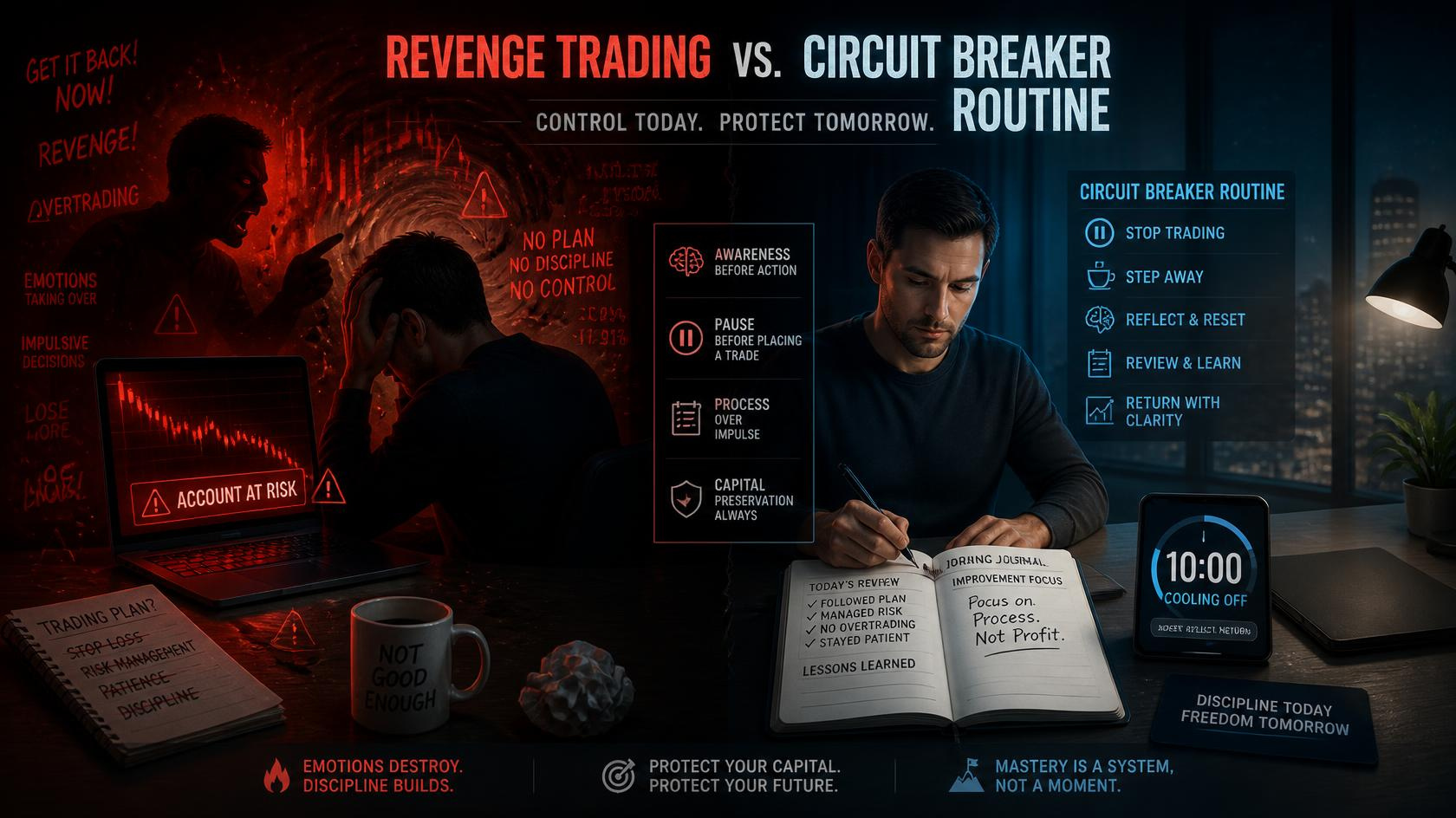
You just took a loss. Maybe it was a good trade that went wrong, maybe you broke a rule. Either way, your heart rate is up and your brain is screaming to open another position right now to get that money back. That impulse is revenge trading, and it destroys more accounts than bad strategy ever will.
Revenge trading happens when you place a trade driven by the need to recover a loss immediately, rather than following your plan. The pattern is predictable: take a loss, feel angry or embarrassed, jump into the next setup without proper analysis, risk too much, lose again, repeat. One bad trade becomes three, and a small daily loss turns into a blown account or a prop firm challenge failure.
This article gives you a concrete routine to stop revenge trading the moment you feel the urge. No theory, just steps you can apply today.
Why Revenge Trading Happens (and Why It Feels So Strong)
Revenge trading is not a strategy problem. It is an emotional response to loss aversion and ego threat. Your brain hates being wrong. A loss feels like a personal failure, and the fastest way to prove you are not a failure is to win the money back immediately.
This is amplified if you are trading with borrowed capital (prop firm accounts), if the loss was large relative to your account, or if you have a string of losses behind you. The emotional need to recover overrides rational decision-making. You skip your checklist, ignore your risk rules, and take setups you would normally pass.
The cycle feeds itself. Each revenge trade increases emotional intensity, making the next impulse harder to resist. Many traders describe it as being on autopilot, watching themselves break rules they know cold.
The 3-Step Routine to Stop Revenge Trading After a Loss
This routine is not about willpower. It is about inserting a circuit breaker between the loss and your next trade.
Step 1: Close Your Platform Immediately
The moment you close a losing trade, close your trading platform. Not minimize it. Close it completely. Walk away from your desk for at least 10 minutes. Go outside, make coffee, do pushups, anything that breaks the physical loop.
This is not optional. The urge to revenge trade peaks in the first 5 to 15 minutes after a loss. If you stay at your screen, you will find a reason to trade. Your brain will manufacture a setup that looks urgent. Removing access removes the option.
Set a timer on your phone for 10 minutes. Do not return to your desk until it goes off.
Step 2: Write Down What Happened Before You Analyze It
After the break, open your trading journal (not your platform). Write three things: what was the trade and what was the outcome, what you are feeling right now, and what your plan says to do next.
Writing forces you to process the loss consciously instead of reacting. It also creates a record. When you read back through your journal later, you will see the pattern: every revenge trade starts with skipping this step.
If you use Tradezona, log the trade immediately with your emotional state and a note about what you are feeling. Zona AI will review your session at the end of the day and call out the pattern if revenge trading is creeping in. The act of logging alone often kills the impulse because it makes the choice explicit.
Step 3: Apply the One-Trade Rule
Do not take another trade until you have reviewed the losing trade and confirmed your next setup meets every entry rule in your plan. Check the losing trade against your plan. Was it a valid entry that got stopped out, or did you break a rule? If you broke a rule, no more trades today. If it was valid, move to the next step.
Wait for your next qualified setup. Do not scan for trades. Let the market come to you. If your plan says you trade only A+ setups, do not take a B setup to get back in action. Write down why the new trade qualifies before you enter.
The one-trade rule prevents the machine-gun revenge spiral. It is much easier to stop yourself before trade two than after trade five.
How to Recognize Revenge Trading Before It Starts
Prevention is easier than cure. Watch for these early warning signs: you feel urgency after a loss, you are scanning for any setup instead of waiting for your setup, you think about position size before you think about the trade idea, you justify a trade by saying it is a quick scalp or just getting even, or you skip steps in your checklist.
If you notice any of these, stop. Walk away. The market will be open tomorrow.
Keeping a trading journal with emotional tags makes these patterns visible. After 20 or 30 trades, you will see the emotional state that precedes your worst decisions. Many traders find that logging frustration or impatience after a loss is enough to remind them not to trade.
What to Do Instead of Revenge Trading
The goal is not to avoid all trading after a loss. The goal is to return to rule-based trading. Review the losing trade in detail, then move on. Ask: did I follow my plan? If yes, it was just a loss. If no, what rule did I break and how do I prevent it next time?
If you are still emotional, end the session. There is no rule that says you must trade every day. Prop firm traders often protect their accounts by stopping after two losses in a session.
Set a cooling-off rule in advance. Many traders use: after any loss over a certain percentage of the account, no more trades until the next session. Make the threshold small enough that it catches you early.
How a Trading Journal Breaks the Revenge Trading Cycle
A trading journal does not stop you from feeling the urge to revenge trade. It stops you from acting on it by making the decision conscious.
When you log every trade with your emotional state and a quick note, you create a feedback loop. You see the pattern: trades taken while angry or frustrated lose more often and lose bigger. You see that your best trades happen when you are calm and patient.
After a few weeks, the journal becomes a mirror. You know when you are about to revenge trade because you have seen the setup before (the emotional setup, not the chart setup). That awareness is often enough to stop the cycle.
Tradezona makes this easier by giving you a place to log emotional state with every trade and by delivering a short daily review from Zona AI that spots repeat patterns. You do not have to analyze your own behavior while you are emotional. The journal does it for you at the end of the day when you are calm.
The One Thing to Remember
Revenge trading is not a sign you are a bad trader. It is a normal response to loss that every trader feels. The difference between traders who survive and traders who blow accounts is a simple routine: close the platform, write it down, wait for the next valid setup.
Start logging your trades today, especially the emotional state after a loss. The pattern will show itself, and once you see it, you can stop it. Start your free trial and build the habit before revenge trading costs you another prop firm challenge or another chunk of your account.
This article is for education only and is not financial advice.
Put this into practice
Tradezona logs your trades, tracks your psychology, and coaches you every session · free for 7 days.
Start Journaling Free