Overtrading: 7 Signs and How to Fix It
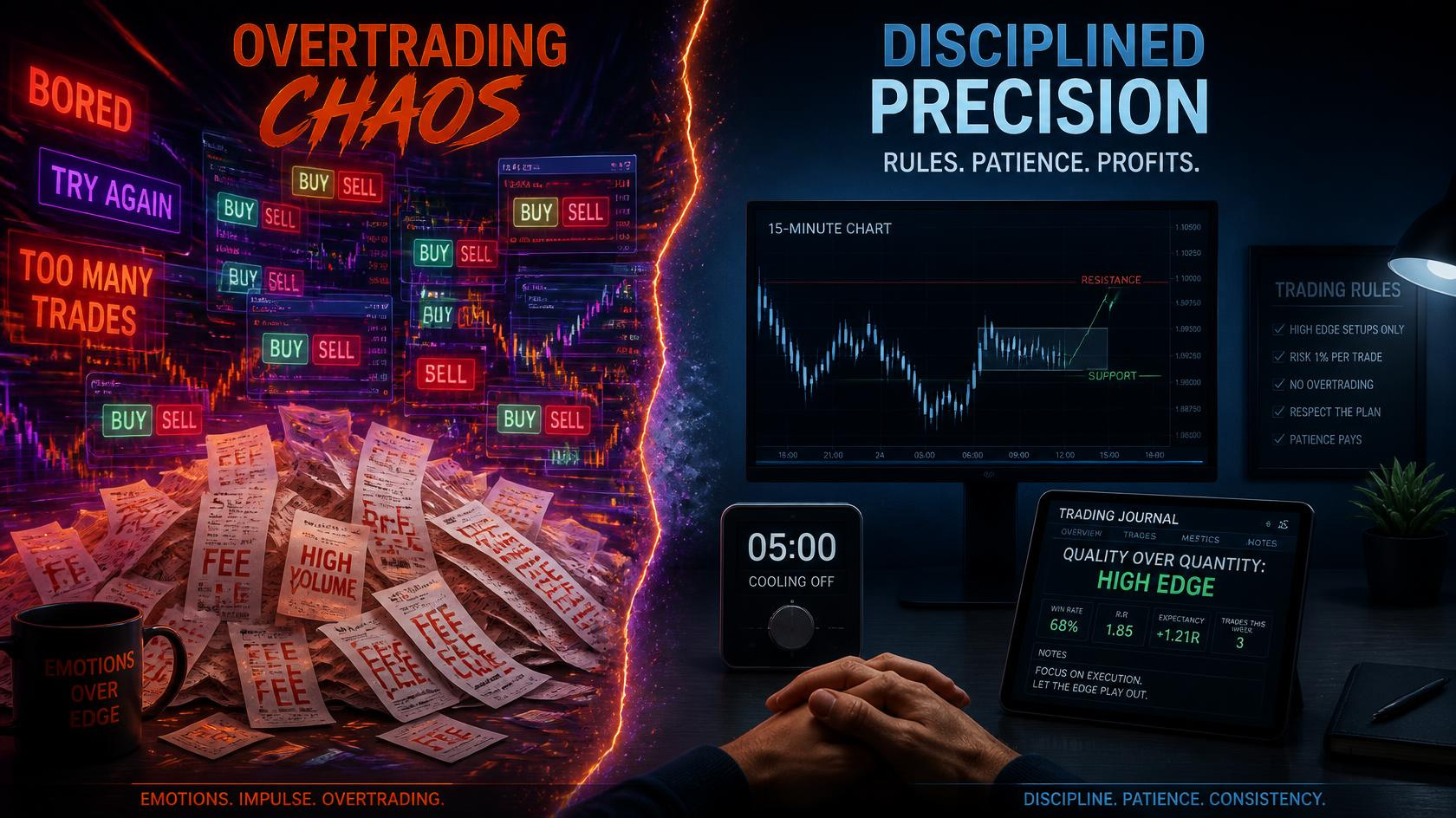
Overtrading happens when you take more trades than your edge and bankroll can support. It shows up as tight clusters of entries, trades outside your plan, or positions opened because you are bored or anxious. Most retail traders know they overtrade, but they do it anyway because the urge to do something feels stronger than the urge to follow the plan.
This article shows you seven concrete signs that you are overtrading and gives you a simple routine to fix each one. The goal is not to trade less for the sake of it. The goal is to trade only when your setup is present and your state is right.
What is overtrading?
Overtrading means entering too many positions relative to your strategy, capital, or risk tolerance. It happens in two main forms. The first is high trade frequency, where you open five, ten, or twenty positions in a session when your tested plan says two or three. The second is oversizing, where each position is too large and one or two losers wipe out a week of gains.
Both forms create the same outcome: you pay more in commissions and spreads, you make decisions while tired or emotional, and you turn a winning edge into a losing month. Overtrading is not about being active. A scalper taking fifty trades a day is fine if that matches the strategy and the trader stays disciplined. Overtrading is taking more trades than the plan allows or more than you can manage well.
7 signs you are overtrading
1. Your win rate drops sharply during certain hours
You check your stats and see that trades between noon and 3 p.m. lose more often than trades in the morning. The setups look the same on the chart, but your execution is sloppy because you are forcing trades to stay busy. If one session or time block has a win rate ten points lower than the rest, you are probably overtrading during that window.
2. You open trades right after a winner or a loser
A winner makes you feel invincible, so you jump into the next setup without waiting for confirmation. A loser makes you feel behind, so you chase the market to get even. Both patterns are revenge trading and euphoria trading. If you can see tight clusters of entries within minutes of each other, especially after a big win or loss, that is overtrading.
3. You break your daily loss limit more than once a month
You set a rule: stop trading after losing a certain amount in one day. Then you hit the limit and keep going, hoping the next trade will fix it. Breaking your stop-loss-for-the-day rule is a direct sign of overtrading and poor risk management. Once is a mistake. Twice in a month is a pattern.
4. Your average hold time keeps shrinking
You planned to hold swing trades for two days, but your actual average is six hours. You cut winners early because you are afraid they will reverse, then you open another trade to replace the dopamine. Shortening hold times without a strategy reason is overtrading disguised as active management.
5. You trade symbols or timeframes outside your plan
Your plan says trade EUR/USD and GBP/USD on the 15-minute chart. You get bored and open a position in an exotic pair or drop to the 1-minute chart because the main plan has no setups. Trading outside your tested universe is overtrading, even if you only do it once a day.
6. Commission and spread costs are eating your profit
You finish the month up in gross profit but down in net profit after fees. High trade frequency means high costs. If commissions and spreads take more than 20 percent of your gross profit, you are likely taking too many trades. This is especially common in prop firm trading, where tight spreads hide the cost until you run the numbers.
7. You feel exhausted after every session
Trading should require focus, but it should not leave you drained. If you close the platform feeling like you ran a marathon, you probably made too many decisions in too short a time. Mental fatigue leads to mistakes, and mistakes lead to more overtrading as you try to fix them.
How to fix overtrading
Fixing overtrading requires changing behavior, not just knowing the problem. Here are practical rules you can apply today.
Set a hard trade limit per day
Decide the maximum number of trades you will take in one session. For example, if your backtested plan shows an average of four trades per day, set your limit at five. When you hit five, you are done. Close the platform or switch to reviewing past trades. A hard limit removes the decision and stops the spiral before it starts.
Log your emotional state before every trade
Before you click the button, write one word describing how you feel: calm, bored, angry, excited, tired. Do this in a notebook or in a trading journal like Tradezona. Over a week, you will see a pattern. If half your losses come from trades marked bored or angry, you know the trigger. Once you see it, you can create a rule: no trades when you feel that way.
Use a mandatory wait time between trades
After you close a trade, set a timer for five or ten minutes. Do not open another position until the timer finishes. This wait time breaks the emotional loop that causes back-to-back entries. It gives you a moment to check if the next setup is real or if you are just reacting.
Review your trade frequency weekly
Every Sunday, look at how many trades you took each day. Compare that number to your plan. If you took twelve trades on Tuesday and your plan says five, mark it. Look for patterns: do you overtrade after a losing day, on Fridays, or during lunch? Awareness is the first step to control.
Track your profit per trade, not just total profit
Divide your weekly profit by the number of trades. If you made $200 on twenty trades, your profit per trade is $10. Now compare that to a week where you made $180 on eight trades. Profit per trade was over $22. Fewer trades, more profit per trade. Seeing this number improve over time when you cut out the junk trades is powerful feedback.
Use a trading journal to spot repeat mistakes
A journal shows you the truth. When you log every trade with notes and emotional tags, you see the same mistakes repeating. Maybe you overtrade every Wednesday, or every time you are up big early in the session. A tool like Tradezona makes this easy because it tracks emotional state, session time, and trade clusters automatically. The Zona AI daily review points out patterns you miss in the moment, like taking too many trades after 2 p.m. or opening positions when you marked yourself as frustrated. Honest logging turns overtrading from a vague feeling into a visible problem you can measure and fix.
Why overtrading happens
Understanding the cause helps you stay ahead of the behavior. Overtrading usually comes from one of three places: boredom, fear, or misunderstanding what edge means.
Boredom is the most common. The market is quiet, your plan has no setups, and sitting still feels like wasting time. So you lower your standards and take a marginal trade. One becomes three, and now you are overtrading.
Fear comes after a loss. You feel behind and you need to recover. The next trade is not about the setup. It is about fixing the emotional pain. That need pushes you into trades that do not meet the plan.
Misunderstanding edge means you think more trades equal more profit. In reality, edge is about probability over many repetitions of the same setup. Taking more trades outside the setup dilutes the edge and adds noise. Quality beats quantity every time.
This article is for education only and is not financial advice.
Put this into practice
Tradezona logs your trades, tracks your psychology, and coaches you every session · free for 7 days.
Start Journaling Free