FOMO Trading: What It Is and How to Beat It for Good
What Is FOMO Trading?
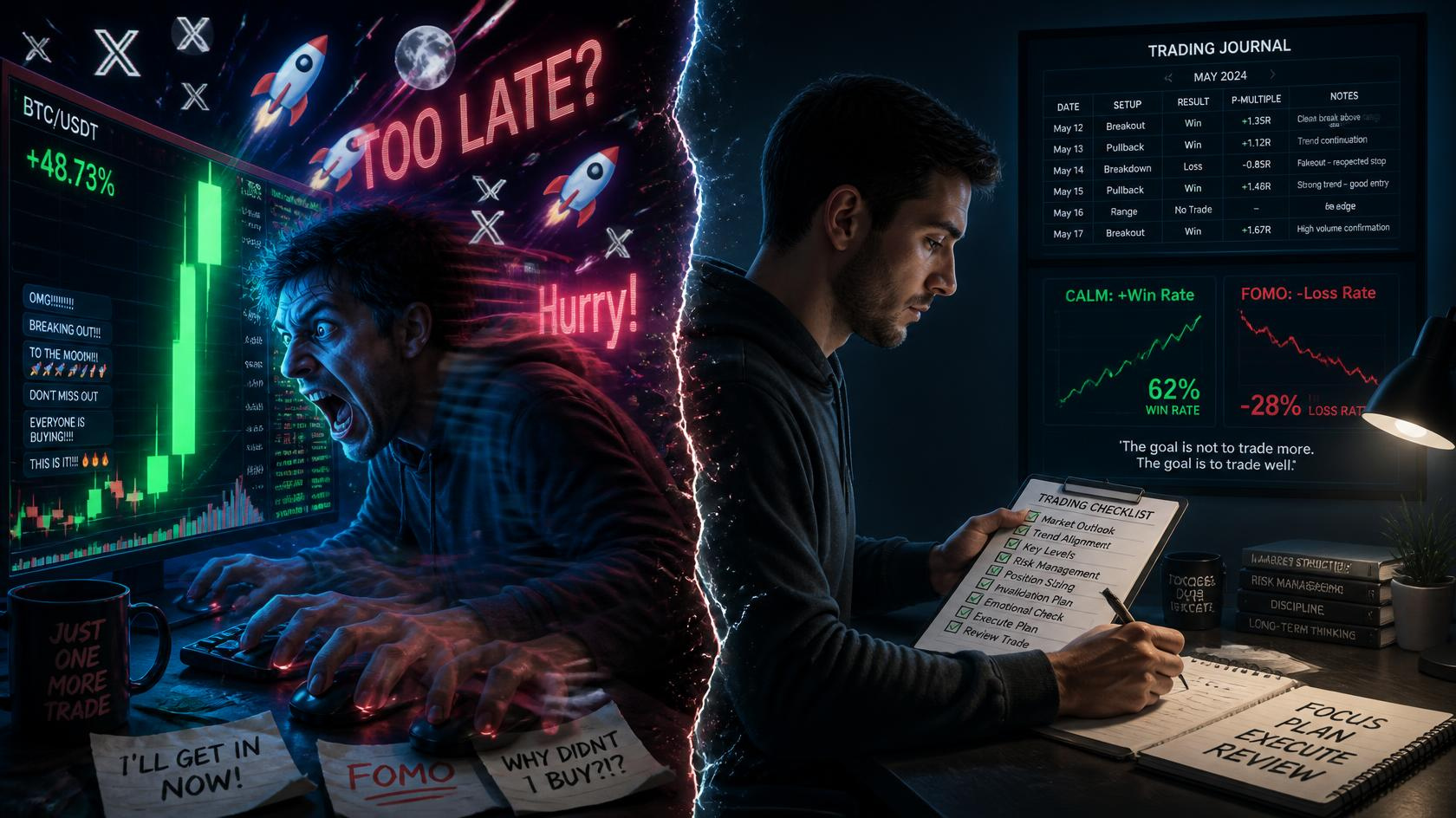
FOMO trading is when you enter a trade because you are afraid of missing out, not because your strategy gave you a signal. The price is running. Everyone on Twitter is posting screenshots. You feel the urge to jump in before it is too late. You click buy or sell without checking your plan. That is FOMO trading.
Fear of missing out is one of the most common reasons retail traders blow their accounts. It makes you chase price, ignore your rules, and take trades you would never take if you were calm. The result is always the same: you enter late, the move ends, and you take a loss that should never have happened.
Why FOMO Happens to Traders
FOMO does not come from nowhere. It comes from specific triggers you can learn to recognize.
You see a big green or red candle and imagine the profit you could have made if you were in. You scroll social media and see other traders posting wins. You have been sitting out for days and you feel left behind. You just closed a losing trade and you want to make the money back fast. You are bored and you want action.
All of these moments create the same feeling: if you do not act right now, you will miss the opportunity forever. Your brain knows that is not true, but your emotions do not care. The fear takes over and you click the button.
How to Recognize FOMO in Your Own Trading
Most traders do not realize they are acting on FOMO until after the trade goes wrong. You can catch it earlier if you know what to look for.
Ask yourself these questions before every trade. Am I entering because my strategy says so or because the price is moving fast? Did I check my plan or am I winging it? Would I take this trade if the chart was not moving right now? Am I trying to recover from a loss or prove something?
If you hesitate on any of those questions, you are probably about to FOMO. Step back. Close the chart. Wait five minutes. If the setup is real, it will still be there.
Keeping a record of your emotional state when you enter helps. When you log how you felt before the trade, patterns show up fast. If every impulsive loss came when you felt anxious or left out, you have found your trigger.
Five Rules to Stop FOMO Trading
Beating FOMO is not about willpower. It is about following a system that removes the decision when emotions are high.
1. Write Down Your Entry Rules and Never Break Them
Your strategy should tell you exactly when to enter. If the conditions are not met, you do not trade. No exceptions. No maybes. When FOMO hits, you check the list. If the setup is not there, you close the platform.
Example: You only take breakout trades after a retest with volume confirmation and a risk-reward ratio above 1:2. If any piece is missing, you wait. That rule alone will stop most FOMO trades.
2. Set a Rule for How Many Trades You Take Per Day
FOMO loves unlimited chances. When you can take as many trades as you want, every move looks like an opportunity. Put a limit on it. Say you only take two trades per day, or three per week. Once you hit the limit, you are done. You can watch, you can learn, but you cannot click.
This forces you to choose quality setups. You will not waste a slot on a FOMO chase when you only get two chances.
3. Use a Pre-Trade Checklist
Before you enter, run through a short checklist. Does this match my plan? What is my stop loss? What is my target? What is my position size? How do I feel right now? If you cannot answer all five in ten seconds, do not take the trade.
The checklist creates a pause. That pause is usually enough to break the emotional spiral. Many traders find this is the single most effective anti-FOMO tool they have.
4. Log Every Trade with Your Emotional State
Write down how you felt when you entered. Calm, anxious, excited, angry, bored, rushed. After a month, look at your results by emotion. You will see that trades taken when you felt rushed or anxious lose money. Trades taken when you felt calm or patient make money.
That pattern makes it easier to walk away next time. You are not guessing whether FOMO is hurting you. You have proof.
5. Accept That You Will Miss Moves
This is the hardest rule and the most important. You cannot catch every move. No one can. The market will make big moves without you every single week for the rest of your career. That is normal. Missing a move does not mean you failed. Taking a bad trade because you were afraid of missing out does.
Your job is not to catch everything. Your job is to follow your plan and take the setups that match your rules. Everything else is noise.
How a Trading Journal Stops FOMO Before It Starts
A trading journal is the best long-term defense against emotional trading. When you review your trades daily, you see the pattern between your feelings and your results. You stop lying to yourself about why you took the trade.
With a tool like Tradezona, you log your emotional state and your trade notes for every position. The AI gives you a short daily review pointing out when you broke your rules or chased price. The analytics show you which emotions cost you money. You see it in black and white: FOMO trades lose. Patient trades win.
That honest feedback loop makes it harder to repeat the mistake. You are not relying on memory or motivation. You have data. Over time, the urge to chase gets weaker because you have trained yourself to recognize it and you know what happens when you give in.
FAQ
What does FOMO stand for in trading?
FOMO stands for fear of missing out. In trading, it means entering a position because you are afraid the price will move without you, not because your strategy gave you a signal. FOMO trades are almost always impulsive and emotional.
How do I know if I am FOMO trading?
You are FOMO trading if you enter without checking your plan, if you feel rushed or anxious before the trade, or if you are trying to catch a move that already happened. Ask yourself: would I take this trade if the chart was not moving right now? If the answer is no, it is FOMO.
Can I ever recover from a FOMO trading habit?
Yes. FOMO is a habit, and habits can be changed with a system. Use a pre-trade checklist, limit how many trades you take per day, and keep a journal that tracks your emotional state. When you review your trades and see the cost of FOMO in your results, it gets easier to walk away next time. Most traders who beat FOMO do it by building routines that remove the emotional decision.
This article is for education only and is not financial advice.
Put this into practice
Tradezona logs your trades, tracks your psychology, and coaches you every session · free for 7 days.
Start Journaling Free