Why You Keep Cutting Winners Short (And How to Finally Stop)
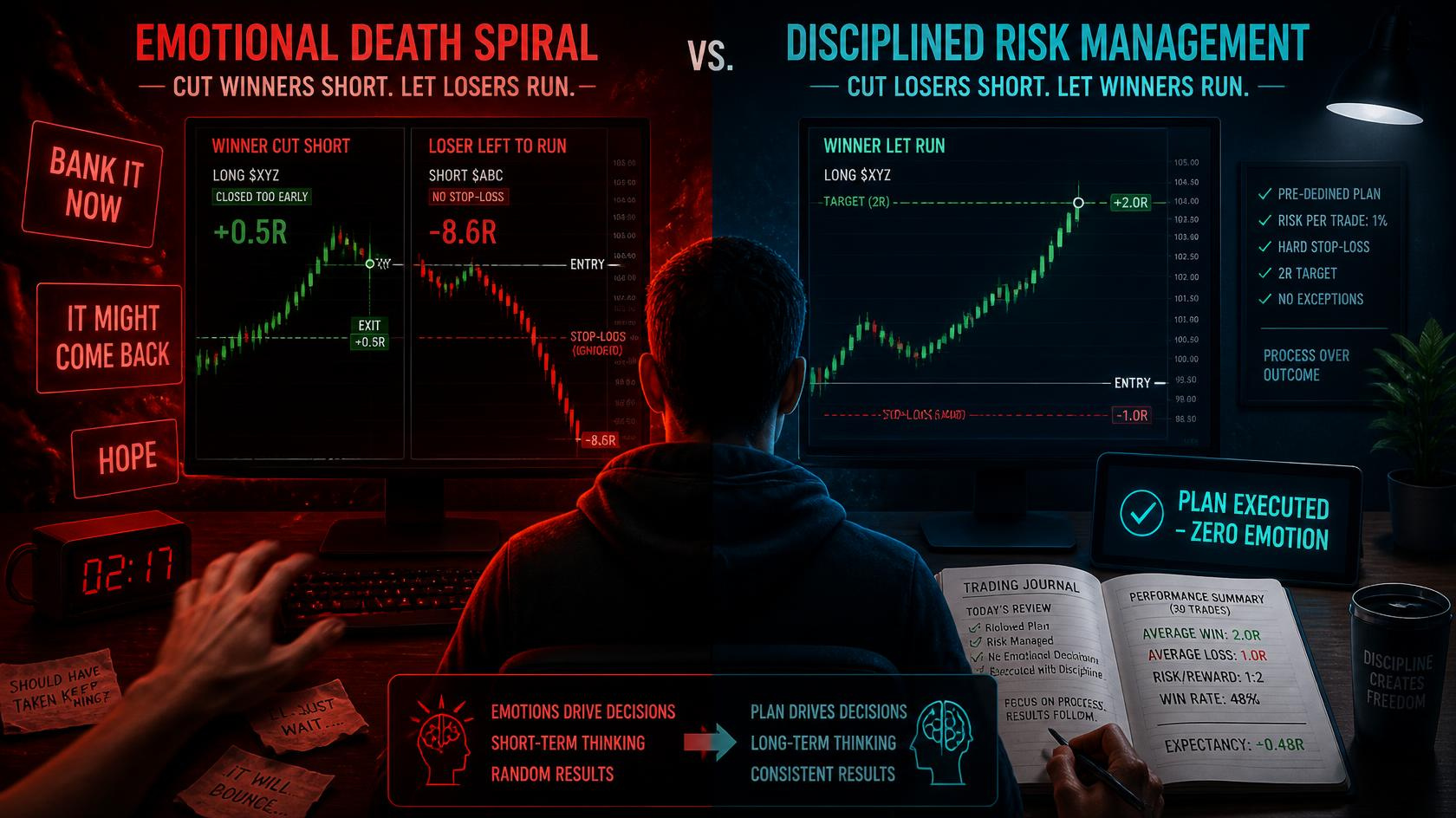
You enter a trade, it moves in your favor, and you feel a rush of relief. Then fear creeps in. What if it reverses? Better lock in the profit now. You close the trade for a small win. An hour later, the market continues in your direction and you watch what could have been a 3R winner turn into a 0.5R exit.
Meanwhile, when a trade goes against you, different logic takes over. It is only a paper loss. It might come back. You hold, add to the position, or move your stop further away. The loss grows.
This is cutting winners short while letting losers run, and it destroys more trading accounts than bad entries ever will. The behavior is not about your strategy. It is about how your brain handles uncertainty and emotional discomfort.
Why Do Traders Cut Winners Short?
Cutting winners short happens because of loss aversion, a cognitive bias where the pain of losing feels roughly twice as strong as the pleasure of winning. When you have an open profit, your brain treats it like money you already own. The thought of watching that profit shrink feels like a loss, so you close early to avoid the pain.
This is the opposite of rational risk management. Your plan might say hold for 2R, but fear convinces you that 0.6R is safer. You trade the feeling, not the plan.
Another driver is the need for certainty. An open trade, even a winning one, creates tension. Your account balance moves every tick. Closing the trade ends the discomfort immediately. That relief becomes a reward, and your brain learns to repeat the behavior.
Some traders also fear being wrong. If the trade reverses after you banked a profit, you were still right. If it reverses while you are still holding, you feel like you made a mistake by not taking profit. The difference is psychological, not financial, but it drives real decisions.
Why Do Traders Let Losers Run?
Holding losing trades works through a different mental trick. When a trade goes against you, closing it makes the loss real. As long as the position is open, you can tell yourself the market might turn around. This is hope disguised as patience.
Traders also fall into the sunk cost trap. You have already lost $200, so closing now feels like giving up. Adding to the position or waiting longer feels like giving the trade a fair chance. The problem is the market does not care about your entry price or how much you have invested emotionally.
Regret aversion plays a role too. If you close a loser and it reverses five minutes later, you will feel foolish. Holding a little longer avoids that specific regret, even though it increases the risk of a much larger loss.
The Deadly Combination
Cutting winners short and holding losers creates a toxic win rate pattern. You might win 70% of your trades, but your average winner is smaller than your average loser. The math does not work. Over time, this behavior guarantees account erosion.
Example: You take 10 trades. You win 7 and lose 3. Your average winner is $50. Your average loser is $150. Total: $350 in wins, $450 in losses. Net result: down $100 despite a 70% win rate.
The strategy might be sound, but the execution kills it.
How to Stop Cutting Winners Short
The fix requires both mindset shifts and mechanical rules that remove decisions from the emotional moment.
Set a Minimum Hold Time
Before entering a trade, decide on a minimum time or price movement before you are allowed to even consider an exit. For example: do not touch the trade for the first 15 minutes, or wait until it reaches at least 1.5R.
This simple delay interrupts the impulse to close early. Often, the initial fear fades and you give the trade room to develop.
Use Partial Exits as a Bridge
If holding the entire position creates unbearable tension, close half at 1R and let the rest run to your target. This gives you the relief of a locked-in win while keeping exposure to the bigger move.
Log this in your journal: did the second half reach target? Over time, the data will show whether partial exits help or hurt your edge.
Reframe Profit as Risk Capital
Once a trade is 1R in profit, move your stop to breakeven and mentally reclassify the open profit. It is no longer your money. It is the market's money that you are trying to capture. This mental trick reduces the fear of giving back gains.
Track Missed Profit in Your Journal
Every time you close a winner early, note where the trade went after you exited. At the end of the week, calculate the total profit you left on the table. Seeing this number in your Tradezona journal creates accountability and makes the cost of early exits impossible to ignore.
How to Stop Letting Losers Run
Fixing the loser side is simpler in concept but harder emotionally.
Hard Stop Loss, No Exceptions
Set your stop when you enter the trade. Do not move it unless the trade moves significantly in your favor. Treat the stop as a non-negotiable exit.
If you find yourself wanting to widen the stop, close the trade instead. That urge is a signal that you are trading hope, not the plan.
Pre-Commit with a Max Loss Rule
Decide before the trading day starts: what is the maximum you will lose today? Example: if you lose 2% of your account, you stop trading for the day. No exceptions, no one more trade to make it back.
This circuit breaker prevents emotional decisions from compounding small losses into account damage.
Log Your Emotional State When Holding Losers
When you hold a losing trade past your stop, write down what you were feeling: hope, frustration, revenge, denial. Over time, patterns emerge. You will notice you hold losers when you are anxious about weekly targets or frustrated after a string of small losses. Awareness is the first step to breaking the cycle.
The Role of Trading Journals
Rules help, but consistency requires feedback. A trading journal shows you the gap between your plan and your execution.
Log every trade with your emotional state at entry and exit. Mark when you cut a winner short and when you held a loser past your stop. After a week, review the data. You will see patterns: you cut winners short after two losing trades, or you hold losers on Fridays when you are trying to hit weekly goals.
Tradezona makes this review automatic. Zona AI reads your trades and emotional notes, then gives you a short daily review pointing out repeat behaviors. You see exactly where discipline broke down, session by session. The calendar heatmap shows which days you followed your rules and which days emotions took over.
The position size calculator helps you set stop losses that match your risk tolerance, so you are less tempted to widen stops when a trade goes against you. The playbook feature lets you define your exact exit rules upfront, so there is no ambiguity in the moment.
This is not about motivation. It is about creating a feedback loop that makes bad habits visible and good habits automatic.
FAQ
Why is cutting winners short worse than it seems?
Cutting winners short destroys your risk-to-reward ratio. Even with a high win rate, if your average winner is smaller than your average loser, you lose money over time. The behavior also reinforces the habit of trading based on fear rather than your plan, which spreads to other parts of your execution.
How long should I hold a winning trade?
Hold until your predefined target or trailing stop is hit. Decide this before you enter the trade, not during. If you set a 2R target, do not close at 0.8R just because you feel nervous. Let the market prove your plan wrong, do not exit based on emotion.
Can you stop these behaviors without a journal?
You can improve with discipline and rules, but without a journal, you are guessing about your patterns. You might think you cut winners short occasionally, but the data might show you do it 60% of the time after losing trades. A journal removes the guesswork and shows you exactly what needs fixing.
Start With One Rule
You do not need to overhaul your entire process today. Pick one rule: set a minimum hold time for winners, or commit to never moving a stop loss further from entry. Apply it for two weeks. Track it in your journal. Adjust based on what the data shows.
Small, consistent changes in execution build into real edge. The strategy is not the problem. The space between the plan and the execution is where most traders lose. Close that gap and the account follows.
This article is for education only and is not financial advice.
Put this into practice
Tradezona logs your trades, tracks your psychology, and coaches you every session · free for 7 days.
Start Journaling Free